
Most parents walk into a six-month toddler dental exam expecting a quick tooth count and a sticker. That is not what the appointment is really for. A toddler visit is a growth and development screen, and the observations your infant dentist makes at 18 and 24 months can shape decisions about bite, airway, speech, and feeding long before any cavity appears.
This guide walks you through what actually happens at that recall, so you can arrive knowing what your dentist is looking at and what each observation means. By the end, you will know which findings deserve a closer look, which simply need watching, and what to ask at your next visit.
Why a Six-Month Toddler Visit Is a Development Screen, Not a Cavity Count
Six months is a framework, not a fixed rule. AAPD periodicity guidance states that recall intervals should reflect each child’s individual needs and risk indicators, so your toddler’s schedule may be six months or something different. The guidance also groups care into age bands, including 6 to 12 months, 12 to 24 months, and 24 months to 6 years. That is why a first visit looks different from the exam at 18 or 24 months.
Early visits establish a dental home, the ongoing relationship with one practice that AAPD guidance treats as the foundation of preventive care. If you are comparing infant dentist options or looking for a children's dentist, this is what you are really seeking: one consistent place with your child’s baseline on file. The first dental visit timing is by age 1, and each recall adds detail to that record.
The visit is a growth and development screen as much as a decay check. Your dentist reviews a range of growth and development markers, then notes each finding for comparison next time.
If you are looking for a dental home in Delaware, First Smile Pediatric Dentistry is a Delaware-based practice led by board-certified pediatric dentist Dr. Morgan Morrow, caring for infants through teens and accepting most insurance plans.
Behavior Shaping: How a Toddler Learns to Sit Through an Exam
Cooperation is taught, not demanded. Pediatric dentists use tell-show-do: name the tool, show it, then use it, often in short sequences. AAPD describes behavior guidance as a continual process, not a one-visit performance. A child who is not ready to sit alone may be examined with a parent close by. Cooperation often builds one small step at a time across recalls. A toddler who allows a partial look now is often ready for more at the next visit.
Timing affects behavior. A calm handoff and a child who is fed but not overfull usually yield a better look than an appointment squeezed in at a rushed moment. At home, read a visit-themed picture book, practice "open wide" with a toothbrush, and let your child hold the mirror. Praise cooperation instead of promising a sweet treat. Prepare for the first visit with these small steps.
Behavior shaping is clinical, not cosmetic. A calm child lets the dentist get a fuller look at the areas where early findings hide. Those observations are why the next parts of the exam matter.
Bite, Jaw Growth, Spacing, and Wear: What the Dentist Is Measuring
Once your toddler settles in, the dentist is already reading the bite. That means looking at how the upper and lower teeth meet, whether the front teeth are crowded or spaced, whether the bite sits open or deep or shifts to one side, and whether the jaw looks symmetric. In plain language, a developing malocclusion is a bite that is changing in a direction worth watching. The AAPD's periodicity guidance treats developing malocclusion and nonnutritive oral habits as legitimate topics for early childhood visits, which is why questions about thumb sucking, pacifier use, and resting mouth posture belong in the exam rather than in small talk. If a habit is in play, what happens when thumb sucking starts to shift teeth is worth reading before your next recall.
During toddlerhood, primary teeth are still arriving, and gaps between them can be normal for a while. Because spacing often changes as neighboring teeth erupt, the dentist compares today with the last visit instead of judging a single snapshot.
Wear patterns, flat spots, and chips get written down because they can point to a habit or an uneven bite. One worn spot is an observation. A pattern that repeats across visits earns a conversation and possibly a referral.
Ask for the words, not just the verdict: "What did you see with the bite today, and what would make you want to look again in six months?" That gives you something concrete to track.
The Questions Your Dentist Asks About Breathing, Snoring, and Oral Habits
Bite notes often lead straight into questions about breathing and habits. Sleep belongs in a dental exam because mouth breathing, snoring, and restless sleep can leave visible clues during an exam. Dentists screen for sleep-disordered breathing and refer when symptoms warrant; diagnosis stays with a pediatrician, ENT, or sleep specialist (AAPD guidance). Estimates for pediatric obstructive sleep apnea run about 1% to 5% of children, with a peak around ages 2 to 7. Those figures often come from school-aged samples, not toddlers, so use them as a reason to report symptoms, not to panic.
Habit questions focus on duration, intensity, and timing. How much of the day is a thumb or pacifier in the mouth? Is it used to fall asleep? Does a bottle or sippy cup go to bed with your child? Does the habit happen only at night? For more toddler dental guidance, browse more toddler dental guidance.
Arrive with observations. Does your toddler snore, breathe through the mouth at rest, wake often, or sound congested most nights? Note it for a week and bring the notes so the dentist can decide whether to watch, ask the pediatrician, or refer. Those notes also set up the next part of the exam, which looks at speech and feeding.
What the Dentist Notices About Speech and Feeding
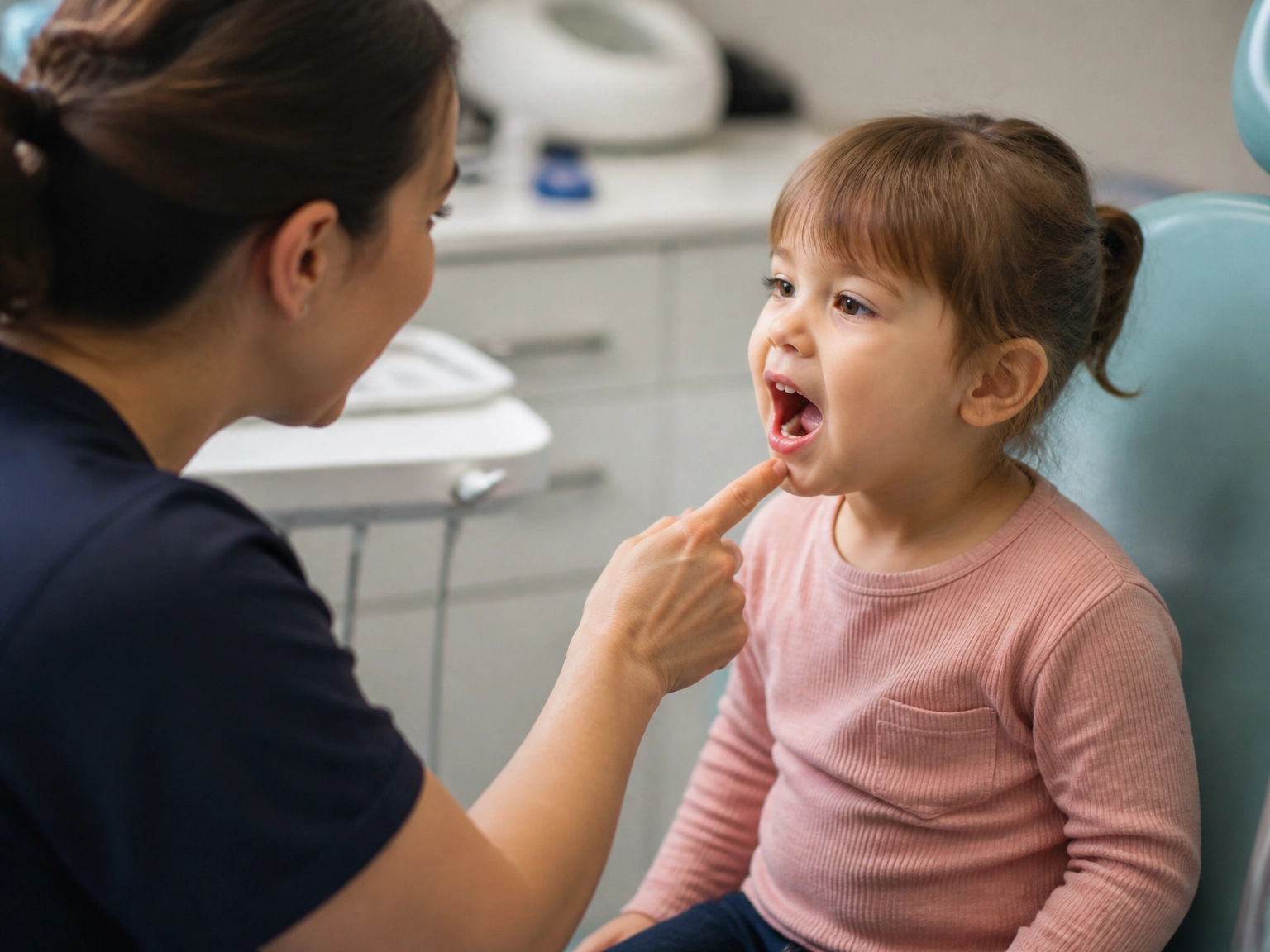
Beyond the breathing questions, the exam moves into how your toddler's mouth functions day to day. This is where a pediatric dentist watches movement, not just structure, as your child talks, eats, and drinks.
When Tongue and Lip Mobility Get a Closer Look
If your child has feeding difficulty, a history of slow or messy eating, or speech that sounds different from peers, the dentist will examine the frenulum, the tissue under the tongue, and check how far the tongue can reach. A restrictive frenum can limit tongue movement, so this is a functional check, not a cosmetic one. If you have ever wondered whether a tongue or lip tie is involved, it helps to know which signs point to a tie before your visit.
Feeding History Is Part of the Recall
Expect ordinary questions about how your child drinks, which textures your child accepts, and how meals are going. These answers tell the dentist how the mouth is working between visits.
Screening, Not Diagnosis
A pediatric dentist does not diagnose a speech disorder, but can recognize the oral-motor patterns that may warrant an evaluation with a speech-language pathologist. Early screening matters because concerns are easier to address before frustration builds.
Bring specifics: words your child says clearly, sounds that seem hard, whether food falls out of the mouth, and how long meals take. Specifics turn a vague worry into something the dentist can act on.
When X-Rays Are Actually Warranted at a Toddler Visit
Speech and feeding observations often lead parents to one more question before the chair reclines: will my toddler need x-rays today?
Not automatically. AAPD radiograph guidance addresses the timing, selection, and frequency of images with one goal in mind: minimizing radiation. Images are prescribed for your child's individual circumstances, not the calendar.
Intraoral radiographs remain the standard diagnostic tool. AAPD guidance names three jobs they do: diagnose disease and trauma, monitor growth and development, and assess how treatment is progressing. For a toddler, a dentist may recommend an image for a suspicious area between teeth that a visual exam cannot see, a fall or blow to a tooth, a suspected eruption or development problem, or a cavity risk assessment that points to hidden decay. Your dentist should name the reason before the sensor comes out.
Expect the smallest number of images that answers the question, protective shielding, and no repeat films without a new reason. Ask why this image now, what changes if you wait, what the result will change about the plan, and what dose is involved. A dentist who welcomes those questions is following the spirit of the guidance. You can meet Dr. Morgan Morrow to see who leads First Smile Pediatric Dentistry's care for infants through teens.
Early Intervention vs. Reassurance: What the Findings Actually Mean
Many x-ray discussions end in a note, not a treatment plan. The same is often true of toddler exam findings: they end in reassurance. Good reassurance should include three things: what was checked, why it looked typical for this age, and what will be compared at the next recall. Ask for that sentence.
When a finding does need action, it usually follows one of three pathways. A bite or jaw observation may lead to an orthodontic assessment later. A breathing concern calls for a medical referral. A speech or feeding concern calls for a speech-language pathologist. Naming the pathway keeps "we will watch it" from becoming "we forgot it."
A finding earns action when it persists across visits, affects eating, sleeping, or speaking, or reflects an ongoing parent concern. A one-time observation with no functional impact usually gets documented and a follow-up date. If your child needs extra preparation for exams, see how we plan calm visits for sensory differences. The dental home is what makes comparison possible: notes, photos, and prior images separate a trend from a coincidence, and AAPD guidance frames that continuity as foundational to preventive care.
Do not wait for the recall if you see pain, swelling, bleeding, a knocked-out or fractured tooth, fever with facial swelling, or breathing that is worsening. Call sooner.
What to Bring and What to Ask at the Next Visit
Before the next recall arrives, prepare one page: a one-week log of snoring, mouth breathing, thumb or pacifier use, bottle and cup habits, and how meals go. Specific notes give the dentist more than a memory of a bad night.
At the visit, ask what was observed in each area, not only whether the teeth look fine. Request the recommended recall interval and the reason behind its length, since AAPD guidance bases timing on individual risk. If a referral is made, follow through within the timeline you were given. Call sooner for pain, trauma, or breathing that is getting worse. For children who find dental visits overwhelming, calmer visits for sensory needs can help the next appointment start smoothly.
Conclusion
A six-month toddler dental exam is a developmental checkpoint, not simply a cavity count. The visit assesses behavior shaping, bite and jaw growth, breathing and sleep habits, and speech and feeding patterns, all of which shape long-term oral health. Early intervention is reserved for concerns with functional impact, while reassurance with a follow-up date is a valid outcome.
That combination of attention and restraint only works when someone keeps watching. Continuity is what makes prevention possible, so keep the next appointment and keep asking questions.