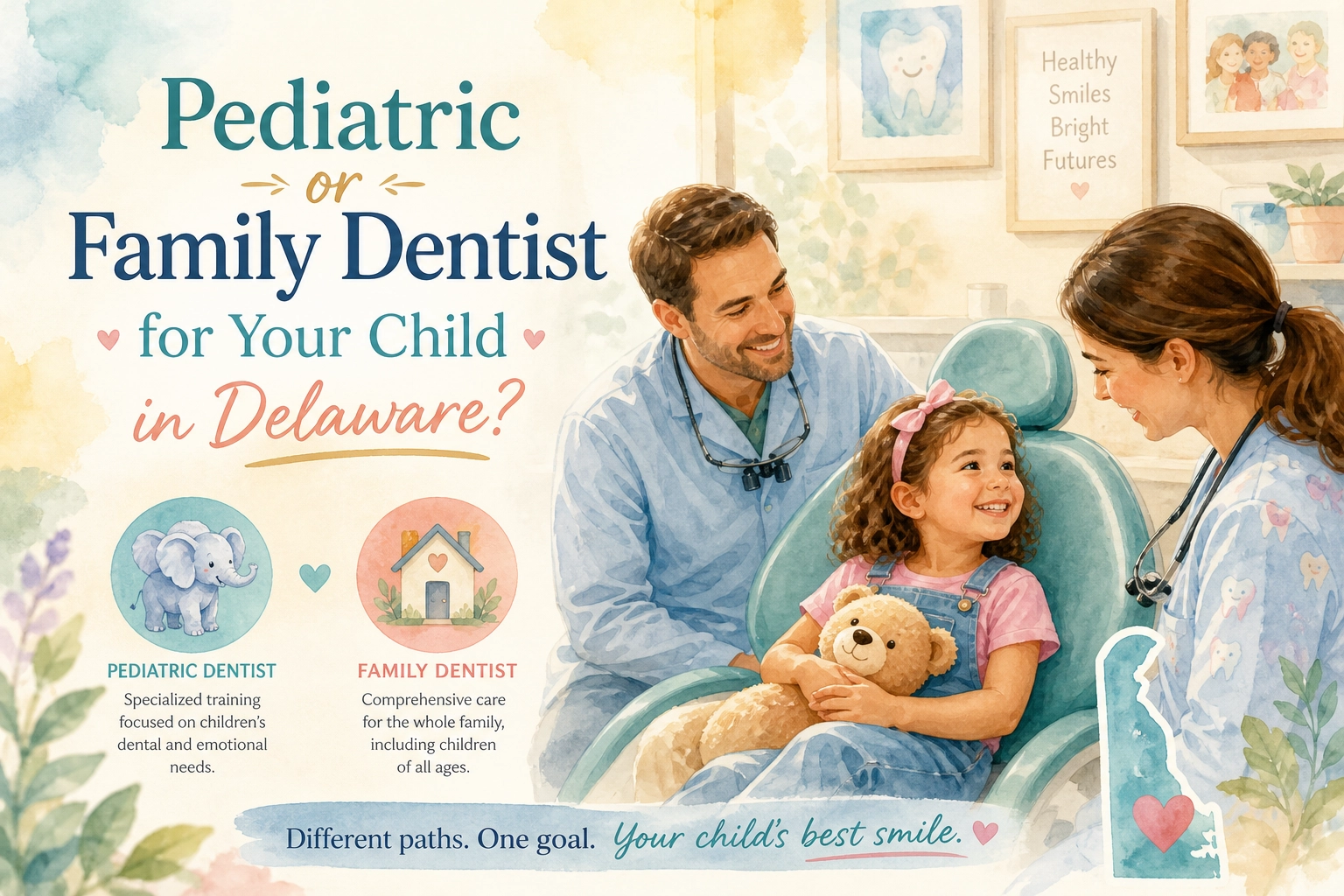
Most parents in Delaware assume any dentist will do for a child. It is a reasonable assumption, but it is worth examining before you book an appointment. The choice between a pediatric dentist and a family dentist is not about finding the "best" dentist overall. It is about matching the specific training of the provider to the specific needs of your child.
The difference comes down to residency training. A pediatric dentist completes specialty education focused on behavior guidance, treating children with special needs, and monitoring growth and development. For most children under twelve, this specialized approach often results in a smoother experience. However, for teenagers or low-needs children, a family dentist can still be the right fit.
This post takes the fork in the road seriously. You will learn what a pediatric residency actually adds, including behavior management and sedation training. We will also cover how to verify credentials, such as board certification, and provide a side-by-side comparison of provider types. Finally, a decision checklist covering age, needs, after-hours access, and insurance will help you make a reasoned choice. By the end, you will know how to match the dentist to the child, ensuring the decision is based on care requirements rather than a label.
The Short Answer for Middletown and Dover Families
For most children under about 12, a board-certified pediatric dentist is worth the switch. That is this practice's recommendation, not a specialty-wide rule, since no AAPD or ABPD source sets a cut-off age. It matters most for anxious, medically complex, or special-needs kids.
The honest other half: a family dentist is a reasonable, sometimes better, choice for teens with uncomplicated needs, and for families who value one office, one record, and an established relationship for everyone in the house.
The real question is not who is better. It is which training matches the child in front of you. A pediatric dentist is not a superior dentist; the pediatric residency is simply a different curriculum, built around children's behavior and development rather than a portion of general training.
Four factors decide it: age and stage, needs and complexity, after-hours access, and insurance. This guide works through each.
If you found us typing pediatric dentist near me or childrens dentist near me, you are choosing a provider, not researching a specialty term. So this is built as a decision guide. Start with what happens at the first visit.
What a Pediatric Residency Adds That a General DDS Doesn't
The fork between the two paths comes after dental school, in postgraduate training.
Pediatric dentistry is a recognized dental specialty. Board certification through the American Board of Pediatric Dentistry requires completing, or being in the final year of, a pediatric residency approved by CODA, or an accredited advanced placement program. Parents can use CODA's program directory to search approved pediatric programs by state and city.
One detail surprises families: ABPD does not accept international pediatric residencies for certification, so training completed abroad is not the same credential.
Pediatric residency training covers behavior guidance, treatment of the developing dentition, and pediatric sedation and hospital settings. Growth monitoring and sedation protocols follow AAPD policy and each practice's own written protocols.
Family dentists do treat children, and many do it well. The difference is that child-specific training is the whole curriculum in a pediatric residency rather than a portion of a general one. For a look at Dr. Morrow's pediatric background, the practice publishes it directly.
Behavior Guidance: The Difference Pediatric Boards Name First
That training surfaces first in behavior guidance. The American Board of Pediatric Dentistry states its diplomates are trained to talk to children and use behavior management strategies that minimize stress and provide a smooth experience. In the chair, that looks like named techniques: tell-show-do, modeling, positive reinforcement, and gradual desensitization, all verified in AAPD behavior guidance recommendations. It does not look like a rushed instruction to just hold still.
A calm first visit is worth more than a fast one that ends in tears, because how a child feels about dentistry early on shapes how they feel about it later. Parents can screen for this training by phone: ask how the office handles a child who refuses to open their mouth. A specific, procedural answer signals trained staff; a vague one does not.
A general dentist who is naturally good with children can still deliver excellent pediatric visits. For sensory needs, ask about autism-friendly visit accommodations.
Growth, Bite, and Development: What Ongoing Monitoring Looks Like
Behavior guidance covers how the visit goes. Growth monitoring covers what visits catch over years. AAPD's developing dentition guidance tracks eruption timing, spacing and crowding, crossbites, and oral habits (AAPD developing dentition guidance). Timing changes outcomes: an early bite issue can be a simpler fix than the same issue after adult teeth settle.
Ask either office who reviews bite and development at each recall, not just cavities, and what finding triggers an orthodontic referral. The honest limit: many family dentists screen and refer on schedule, so ask when they refer and to whom.
Parents searching for a dentist for kids often expect cavity care. Developmental monitoring is easy to overlook, and it is a core part of pediatric residency training. At First Smile, Dr. Morgan Morrow's background reflects that lens.
Special-Needs Care, Sedation, and Kid-Sized Equipment
That developmental lens matters most for children whose needs go beyond routine checkups. Children with significant medical complexity or special health care needs often need a visit adapted to them, and sometimes sedation or hospital-based care. Treat sedation as a clinical program, not an add-on. Ask who administers it, which medications, how recovery is monitored, and what fasting rules apply. Confirm answers against current AAPD sedation guidance and the practice's written protocols. Ask whether the office stocks smaller prophy cups, child-sized bite blocks, and child-proportion sensors; a pediatric office should answer plainly. For special-needs families, ask three questions: Are longer or quieter appointments available? Is a pre-visit tour or photo social story offered? Can the same hygienist be requested each visit? If general anesthesia may be needed, ask whether the dentist holds hospital privileges. When comparing offices, review the practice’s range of pediatric services.
Licensed vs. Board-Certified: The Credential Most Parents Never Check
Once you know what to ask about sedation and hospital privileges, the next question is the credential itself. Every practicing dentist is licensed by the state, but board certification is a separate, voluntary credential from the American Board of Pediatric Dentistry (ABPD). Many practice websites blur the two.
Certification requires completion of, or final-year enrollment in, a CODA-approved pediatric residency or accredited advanced placement program, plus a dual-examination process that takes at least two years. It is maintained, not earned once; ABPD says diplomates complete annual training tied to evidence-based care.
Ask the front desk exactly: “Is the dentist a board-certified pediatric dentist and a diplomate of the ABPD? If not yet, where is she in the certification process?” Do not accept “pediatric dentist” as a credential by itself. An office that treats every age group may have a general dentist who sees children. That can be fine care, but it is not the same training. For verified pediatric care in Delaware, see our board-certified pediatric dentist.
Where a Family Dentist Is Genuinely the Right Call
That credential matters most when a child actually needs it. When one doesn't, staying put is a reasoned decision, not a negligent one.
Teens with fully erupted adult teeth and no orthodontic complexity lose little. The pediatric skills that carry the most weight, guiding a frightened four-year-old and tracking growth, matter less once the bite has largely settled.
A low-needs child is similar: no cavities, no anxiety, no medical complexity, and a comfortable relationship already in place. Weigh the switch honestly. A new office, fresh insurance verification, and rebuilding trust a child has already built are real costs.
Some families deliberately run one office for everyone. Shared records, same-day sibling appointments, and a dentist who knows the whole household are legitimate reasons.
A child mid-treatment should usually finish. Completing a restoration plan or an orthodontic sequence with the current dentist beats switching providers partway through.
Treat a referral as the answer. When your family dentist sends you out for sedation, special-needs accommodation, or interceptive orthodontics, that is the signal to make a pediatric dentist the primary, not an occasional stop. For practical guidance between visits, browse our child dental guides.
Side-by-Side: Pediatric Dentist vs. Family Dentist
The family-dentist cases above are real. For everyone else, the table below shows where the two paths diverge.
Pediatric dentist | Family dentist | |
|---|---|---|
Training and credential | CODA-approved residency; optional ABPD board certification, maintained annually | General dental degree; licensed for all ages |
Behavior approach | Behavior guidance as core curriculum | Personal skill; varies by dentist |
Scope of care | Monitoring developing dentition; sedation or hospital options where the practice documents them | Routine pediatric preventive and restorative work; refers complex behavior, sedation, or growth needs out |
Continuity and convenience | Child-focused office; adults may need a second provider | One office, one record for the whole family |
Insurance and after-hours access | Confirm with each office | Confirm with each office |
Read down your child's column, not across the rows looking for a winner. Neither column ranks practices.
Skill varies from dentist to dentist, so the credential question and the phone questions matter more than the category label.
Your Decision Checklist: Age, Needs, After-Hours Access, Insurance
Use the table as a map, then score your own child on five factors. Age and stage: as a rule of thumb, from first tooth through roughly age 12, the pediatric model fits most children well; see our teething signs and timeline for the earliest stage. A teen with full adult dentition can go either way, so let needs decide. Needs and complexity: anxiety, sensory needs, a chronic medical condition, prior sedation or hospital care, or an interceptive orthodontic concern all point toward a board-certified pediatric dentist. After-hours access: ask both offices who answers at 9 pm for a knocked-out tooth or facial swelling, whether there is an on-call line, and where urgent care happens. Write answers side by side. Insurance and cost: confirm in-network status, referral rules, sedation costs beyond the standard visit, and payment plans. Request a written pre-treatment estimate. Convenience and continuity: compare distance from Middletown or Dover, school-hours availability, sibling scheduling, and first-appointment wait. As this practice's rule of thumb, and not a validated cutoff, three or more pediatric checks is a strong signal; zero is a strong signal the other way.
How to Verify a Pediatric Dentist Before You Book
Start by checking the name yourself. Enter the dentist's name in the American Board of Pediatric Dentistry's public Find a Board-Certified Dentist directory to see whether they hold active diplomate status.
Then confirm current standing with ABPD's credential-verification tool. Board status is maintained annually, so a lapsed listing can still appear as a credential on an office website. Treat the directory as a starting point, not proof. ABPD disclaims endorsement and guarantees no accuracy for listed individuals, so confirm the details directly with the office.
Send one email with four questions: Where was the pediatric residency completed? Is the dentist board-certified, and in what year? What sedation credentials does the office hold? If sedation is offered, does the dentist have hospital privileges?
For families in Middletown and Dover, First Smile Pediatric Dentistry is led by board-certified pediatric dentist Dr. Morgan Morrow, treats infants through teens, accepts most insurance plans, and offers flexible payment options.
Match the Dentist to the Child, Not the Label
Read the child, not the label. Verify credentials using the steps above, then ask the after-hours and insurance questions before you commit.
Conclusion

Choosing between a pediatric dentist and a family dentist is not about which title sounds better. It is about matching the provider to your child's age, anxiety level, medical complexity, and likelihood of needing sedation. For children under about 12, or those who are anxious, medically complex, or facing sedation, a board-certified pediatric dentist is the safer match, and that credential is worth verifying on abpd.org before you book. For a low-needs teen with settled teeth and a comfortable relationship with the family dentist, staying put is reasoned as long as bite changes and referrals stay monitored. Either way, ask the after-hours question and get sedation and insurance costs in writing.
Families in Middletown and Dover can begin with First Smile Pediatric Dentistry, where board-certified pediatric dentist Dr. Morgan Morrow treats infants through teens, accepts most insurance plans, and offers flexible payment options. Choose with facts, not first impressions.